.png)
Best Places to Work Remotely in Italy in 2026

Updated: 7 days ago

The best places to work remotely in Italy in 2026 are Lazio, Tuscany, Puglia, Sicily, and the Lake Maggiore area, each offering a different balance of cost, connectivity, community, and access to the rest of the country. Italy has become one of the most popular remote work destinations in Europe, not just for the lifestyle but because the infrastructure has genuinely caught up: Starlink has reached most rural areas, direct train connections make city access easy from the countryside, and a growing number of dedicated coliving and co-working spaces have made longer stays practical rather than just romantic.
What makes a place in Italy good for remote work?
Before getting into the regions, it is worth being clear about what actually matters when you are working remotely from Italy rather than just visiting.
Four things decide whether a base works: reliable internet, a proper place to sit and concentrate, a kitchen so you are not eating out every meal, and enough of a social structure that you are not completely isolated after six hours at a desk.
Major cities like Rome and Milan tick the first two boxes but struggle with the third and fourth. A furnished apartment in central Rome is expensive, noisy, and leaves you figuring out everything alone.
The countryside and smaller cities have quietly become the smarter answer for remote workers who want to actually live somewhere rather than just pass through it.
Lazio and the countryside near Rome
Lazio is the most underrated remote work region in Italy and it is not particularly close. You get direct train access to Rome in 40 minutes, some of the most dramatic countryside in central Italy, lower costs than Tuscany, and a string of genuinely extraordinary day trips within an hour of wherever you are based.
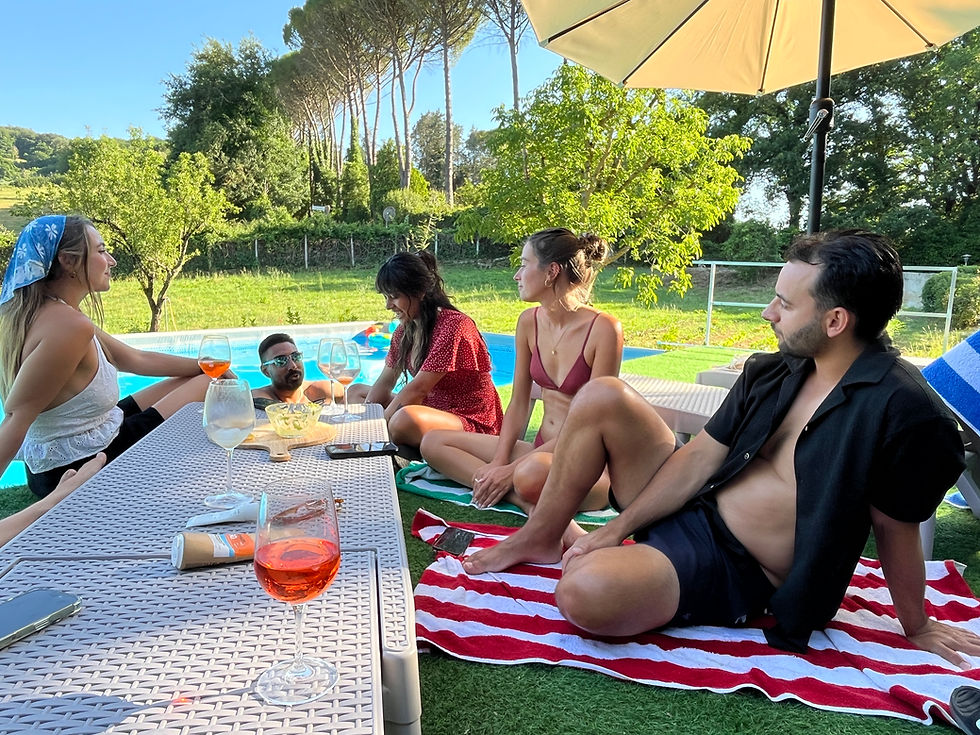
The area around Orte in northern Lazio is where Nesting Away sits, a seven-room coliving villa that has become a natural base for remote workers who want the countryside without giving up city access.
Guests who come through here regularly tell us they chose Lazio over Tuscany because the train to Rome made the location feel practical rather than remote. The Etruscan hilltowns, Lago di Bolsena, Civita di Bagnoregio, and natural wine estates like Sassotondo are all within an hour by car.
For remote workers who want to be a digital nomad in Italy without the chaos of a major city, northern Lazio is consistently the answer that surprises people most.

Tuscany
Tuscany is the obvious choice and still earns it. The Mugello valley, the hills around Siena and Arezzo, and the Chianti region all work well as bases for longer remote work stays. Florence is accessible by direct train from most of the region, the food and wine culture is world class, and the landscape does not disappoint.
The trade-off is cost. Tuscany consistently runs more expensive than Lazio or Puglia, both for accommodation and daily life. It also draws more tourists than northern Lazio, which can make the quieter countryside feel less accessible if you are relying on public transport.
Tertulia Farm in the Mugello valley is one of the few dedicated coliving options in the region, with a farm setting about an hour from Florence and a focus on slow living and sustainability.
Best for: remote workers who prioritize landscape and food culture and have a slightly higher monthly budget.
Puglia
Puglia is where you go when you want to disappear into real Italy. The Valle d'Itria, the area around Alberobello and Ostuni, and the Adriatic coast all offer genuinely rural bases with lower costs than anywhere in the north or centre.
Masseria Olga near Putignano is one of the best examples of what a longer stay in Puglia looks like: a historic farmhouse with private rooms, Starlink wifi, and the trulli landscape right outside the door.
The honest trade-off with Puglia is access. It is not a hub you fly into and out of easily, and getting to other parts of Italy requires either a long train journey or a flight.
For remote workers who want to base themselves for a full month or more without moving around, that is fine. For people who want to use Italy as a hub for weekend trips across Europe, the north or centre makes more logistical sense.
Best for: longer stays, lower budgets, people who want genuine rural immersion without tourist infrastructure.

Sicily
Sicily in 2026 is genuinely having a moment as a remote work destination. Palermo in particular has developed a small but real digital nomad scene, with BeetCommunity operating two urban coliving spaces in the city and a cost of living that sits among the lowest in western Europe.
The food culture is exceptional, the architecture is unlike anywhere else in Italy, and spring and autumn offer some of the best weather on the continent.
The caveat is summer. July and August in Sicily are hot enough to make outdoor work impractical, and the tourist crowds in certain areas can change the feeling of the place significantly.
For remote workers targeting spring or autumn, and especially those on a tighter budget, Sicily is one of the most compelling options in the whole country.
Best for: budget-conscious remote workers, spring and autumn stays, people who want an urban Italian experience at countryside prices.
Lake Maggiore and the Italian north
Lake Como and the pre-Alps above Lago Maggiore are the choice for remote workers who want dramatic scenery and mountain air over warm countryside. The area attracts a different type of remote worker: people who want hiking, clean air, and a slower pace rather than cultural immersion and train access to major cities.
Montino Coliving above Lago Maggiore is one of the most established options in the north, with a mountain setting, daily yoga, and a focus on slow living.
The trade-off is cost and accessibility. The north is the most expensive region on this list, and getting to Milan or beyond requires more planning than hopping a train from Orte to Rome. It is also genuinely remote in a way that Lazio and Tuscany are not, which is exactly the appeal for the right person.
Best for: remote workers who prioritize nature and mountain scenery, and those willing to pay more for a quieter, more immersive experience.
How do you choose the right region for remote work in Italy?
The honest answer is that it depends on what you are optimizing for. Here is a simple way to think about it:
If you want easy city access and countryside calm: Lazio near Rome
If you want the classic Italian landscape and do not mind higher costs: Tuscany
If you want genuine rural immersion on a lower budget: Puglia
If you want urban Italy at low cost, best in spring or autumn: Sicily
If you want mountain scenery and slow living: Lake Como and the north
Most remote workers who come to Italy for a month or more end up choosing based on train access and budget first, and letting the landscape be a happy bonus. On that basis Lazio and Tuscany win for flexibility, while Puglia and Sicily win for value.
FAQ
Where is the best place in Italy for digital nomads in 2026?
The best base depends on your priorities, but Lazio near Rome consistently offers the best balance of countryside calm, fast internet, city access, and cost. Northern Lazio is 40 minutes from Roma Termini by direct train with coliving options starting at €33 per night all-inclusive.
Is rural Italy good for remote work, or is the internet too slow?
Rural Italy has changed significantly in the last two years. Most dedicated remote work bases and coliving spaces now run on Starlink, which delivers reliable speeds well above what most video calls and collaborative work require. Always confirm before booking, but slow rural internet is no longer the barrier it was in 2022 or 2023.
Do I need a car to work remotely in Italy?
Not always. Several of the best remote work bases in Italy sit within walking distance of a train station, or offer organized transport to the nearest town. Nesting Away in Lazio, for example, is a short drive from Orte station with direct trains to Rome, Florence, and Fiumicino Airport. A car gives you more freedom for day trips but is not essential for daily life at most coliving spaces.
🪺 Nesto's tip
Every guest who arrives in Lazio has usually considered Tuscany first. Most of them figure out within a week why they made the right call. The train to Rome helps. So does the fact that nobody else has discovered northern Lazio yet.
Curious if Nesting Away is the right fit?
Comments